
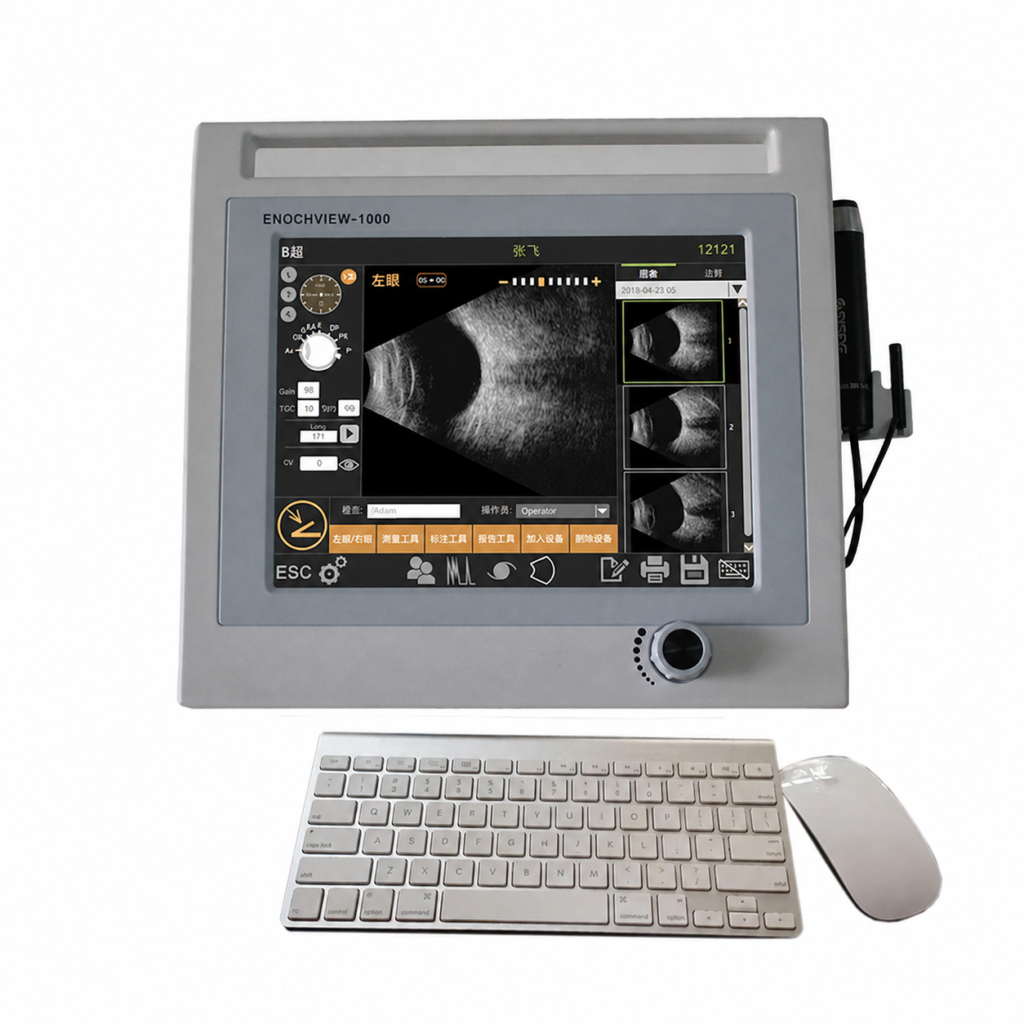
Enochview-1000 Ophthalmic A/B Ultrasound Scanner
The ENOCHTEC Enochview-1000 is an ophthalmic A/B scanner that combines contact A-scan biometry and B-scan ocular imaging in one 12.1-inch color touchscreen system. It supports axial measurements, IOL calculation and posterior-segment examination workflows for ophthalmology clinics, hospitals and surgical departments.
What Does the Enochview-1000 Do?
The system brings quantitative A-scan biometry and cross-sectional B-scan imaging into a compact workstation. Stored and frozen images can be reviewed with adjustable parameters, helping clinicians organize measurement and imaging records while keeping examination controls in one interface.
A-Scan vs B-Scan: What Is the Difference?
Ophthalmic ultrasound uses two complementary display modes, and the Enochview-1000 provides both in one system:
- A-scan (amplitude mode) sends a single beam along the axis of the eye and displays the returning echoes as spikes on a one-dimensional trace. The distances between the spikes give anterior chamber depth, lens thickness and axial length, the measurements used for IOL power calculation.
- B-scan (brightness mode) sweeps the beam across the eye and builds a two-dimensional, cross-sectional image in which echo strength is shown as brightness. It shows the position, shape and size of structures in the vitreous cavity, retina and posterior eye wall.
In short, the A-scan measures and the B-scan visualizes. A combined A/B scan system lets a clinic handle cataract biometry and posterior-segment ultrasound imaging at the same workstation.
A-Scan Biometry and IOL Calculation
The 10 MHz contact A-scan measures ocular dimensions used in cataract-planning workflows, including anterior chamber depth, lens thickness and axial length. A measurement group contains ten readings that can be averaged automatically. The system also supports configurable A constants and established IOL calculation formulas.
- Contact A-scan measurement from over 5 mm to 40 mm.
- Measuring error of no more than 0.05 mm.
- Automatic calculation and result analysis.
- Automatic, preservable and manual image-freezing options.
- SRK-T, SRK II, Holladay, Binkhorst-II, Hoffer-Q and Haigis formulas.
B-Scan Imaging and Review
The 10 MHz B-scan provides ocular profile images with a probing depth of at least 50 mm. Its electromagnetic-drive design supports the probe mechanism, while post-processing tools allow users to measure area and length and add marks or annotations. Up to 100 images can be reviewed for comparison and documentation.
- Axial resolution of 0.2 mm or better and lateral resolution of 0.3 mm or better.
- Gain adjustment from 20 to 110 dB and time-gain adjustment from 0 to 30 dB.
- Eyecup, gel and aqueous-capsule operating modes.
- Area, length, mark and annotation tools.
Clinical Applications
Qualified eye-care professionals can use the Enochview-1000 for ocular biometry and B-scan visualization when direct posterior-segment examination is limited. The exact examination protocol and clinical suitability depend on the approved model instructions and the individual assessment. Findings must always be interpreted by a qualified clinician together with the complete clinical evaluation.
When Is B-Scan Ultrasound Used?
B-scan ultrasound is most useful when the back of the eye cannot be seen directly with a slit lamp or ophthalmoscope, for example because of a dense cataract, a corneal opacity or a vitreous hemorrhage. Sound waves pass through these media, so the posterior segment can still be assessed. Typical questions a B-scan helps to answer include:
- Is the retina or choroid attached?
- Are there vitreous opacities or a posterior vitreous detachment?
- Is an intraocular foreign body suspected after trauma?
- Is there a mass or another change in the posterior eye wall?
Which examinations are performed, and how the images are interpreted, remains the decision of the treating clinician.
Ultrasound, Optical Biometry and OCT
Optical biometers such as the AL-VIEW Lite Optical Biometer measure the eye without contact, but their light signal needs a sufficiently clear optical path. When a dense cataract or another opacity blocks that path, contact A-scan ultrasound can still measure axial length, which is why many cataract services keep ultrasound biometry available alongside optical biometry. With contact A-scan, gentle and consistent probe placement matters, because pressing on the cornea can shorten the measured axial length.
Likewise, an OCT system such as the OCT-500 Spectral-Domain OCT produces far finer images of the retinal layers, but it also requires clear media. B-scan ultrasound provides lower-resolution images that can be obtained through opaque media, so OCT and B-scan answer different clinical questions.
What Should Buyers Confirm Before Ordering?
Before quotation, confirm the required A-scan and B-scan probes, contact accessories, reporting workflow, interface language, local power standard and destination-market documentation. Review the Diagnostic & Imaging equipment range and Ophthalmology Clinic Solution for wider equipment planning. Contact ENOCHTEC to confirm the final configuration.
What Affects the Price of an A/B Scan System?
The quoted price of an ophthalmic A/B scan depends on the complete configuration rather than on the main unit alone. The main factors are the A-scan and B-scan probes and any spare probes, contact accessories, reporting requirements, the interface language, the local power standard, the documentation required for the destination market, and the shipping terms. Including these points in your enquiry allows ENOCHTEC to prepare an accurate, comparable quotation.
Frequently Asked Questions
Is the Enochview-1000 an A-scan or B-scan?
It combines both functions: contact A-scan biometry for ocular measurements and B-scan ultrasound imaging for ocular profile visualization.
How many A-scan measurements are averaged?
One measurement group contains ten readings, which the system can average for review.
Which IOL formulas are available?
The formulas are SRK-T, SRK II, Holladay, Binkhorst-II, Hoffer-Q and Haigis.
What B-scan review tools are included?
The system provides area and length measurement, marking and annotation, plus review of up to 100 images.
What is the difference between an A-scan and a B-scan?
An A-scan is a one-dimensional measurement trace used mainly for axial length and IOL calculation. A B-scan is a two-dimensional cross-sectional image used to examine the vitreous, retina and posterior eye wall. The Enochview-1000 provides both.
What probe frequency does the Enochview-1000 use?
Both the A-scan and the B-scan operate at 10 MHz.
Why keep ultrasound biometry if an optical biometer is available?
Optical biometry needs a clear optical path. When a dense cataract or another opacity blocks the signal, contact A-scan ultrasound can still be used to measure axial length, so the two methods complement each other.


