
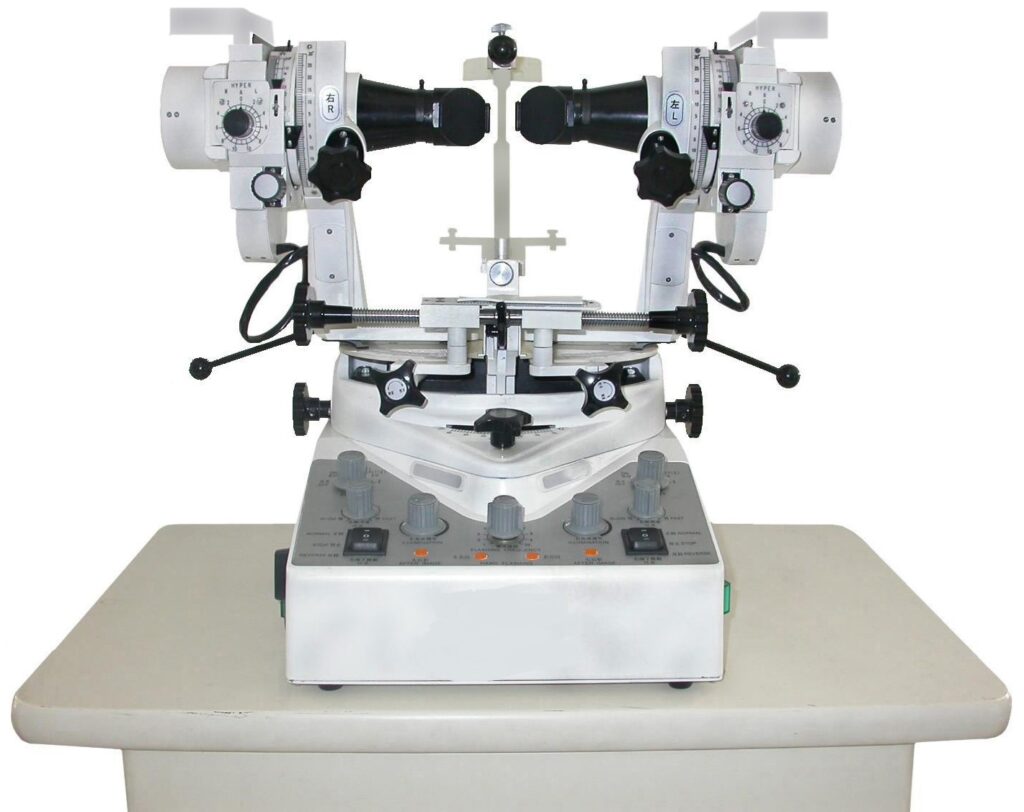
Synoptophore for binocular vision assessment and orthoptic training
The TS-23N synoptophore is a professional ophthalmic instrument designed for binocular vision assessment, measurement and orthoptic training. It supports professional binocular-vision workflows involving simultaneous perception, fusion, stereopsis and retinal correspondence.
Its combined optical, mechanical and electrical design allows the examiner to control the horizontal, vertical and torsional relationship between the two viewing tubes. A transflective viewing system helps the operator observe ocular position and corneal reflections while the patient views the selected slide pair.
What is a synoptophore (major amblyoscope)?
A synoptophore, also called a major amblyoscope, is a table-mounted instrument that shows a separate picture to each eye through two movable viewing tubes, so the examiner can measure how well the two eyes work together. Because each eye sees only its own slide, the instrument can separate what each eye perceives and then test whether the brain combines the two images into one.
The examiner moves the tubes horizontally, vertically and torsionally until the two pictures are aligned, then reads the angle from the instrument. On the TS-23N, the tubes offer 50° of convergence, 40° of divergence and ±30° of vertical movement, and each slide can be rotated by ±20°.
Assessment and training functions in one instrument
The TS-23N supports simultaneous perception, fusion and stereoscopic vision exercises, as well as after-image observation, red-light flashing and Haidinger’s Brush training. Manual and automatic flashing modes provide flexible timing patterns, while the automatic frequency can be adjusted through ten levels from 30 to 300 flashes per minute.
The instrument uses LED illumination. Slide brightness can be adjusted for the examination or training task. The instrument also includes adjustable interpupillary distance, chin rest and forehead rest controls to support patient positioning.
Twenty pairs of slides for structured binocular vision workflows
The standard reference configuration includes 20 pairs of slides covering simultaneous perception, fusion, stereopsis, after-image, Kappa-angle and training applications. Slide designs include large and small angular targets, peripheral and macular fusion targets, stereoscopic targets and random-dot patterns. Optional slides can support quantitative stereopsis assessment from 40 to 1000 arc seconds.
How is a synoptophore test performed?
A synoptophore test checks the three grades of binocular vision in order: simultaneous perception, fusion and stereopsis. Each grade uses its own type of slide pair.
- Simultaneous perception. The two slides show different pictures, such as a bird on one side and a cage on the other. The patient moves one tube until the bird appears inside the cage; the reading at that point is the subjective angle. The examiner can also find the objective angle by lighting each tube in turn and adjusting until the eyes no longer move to take up fixation.
- Fusion. The two slides show the same picture, each with a small control detail missing on the other side. When the patient sees one complete picture, the examiner moves the tubes inward and outward to measure how far fusion can be held before the picture splits.
- Stereopsis. The slides are designed to give a three-dimensional impression when fused. Optional graded slides allow quantitative stereopsis assessment; for the TS-23N these cover 40 to 1000 arc seconds.
Comparing the subjective and objective angles helps assess retinal correspondence: when the two angles match, correspondence is usually normal; a difference between them (the angle of anomaly) points to abnormal retinal correspondence. The after-image and Haidinger’s Brush functions can support further correspondence and fixation work. The test sequence and interpretation are decided by the examining clinician.
Synoptophore vs other binocular vision tests
The synoptophore is usually used alongside other binocular vision tests rather than instead of them. Cover and prism cover tests measure the deviation while the patient looks at a real target. The Worth four-dot test checks fusion and suppression. Near stereotests such as Titmus, TNO or Lang measure stereoacuity with a simple card or booklet.
What the synoptophore adds is control: each eye is presented separately, the deviation can be measured in horizontal, vertical and torsional directions on one instrument, and the same instrument can be used for simultaneous perception, fusion and stereopsis training. Because the viewing conditions differ from free space, clinicians generally interpret synoptophore readings together with their other orthoptic findings.
Designed for hospitals, eye clinics and orthoptic departments
The TS-23N can be considered for ophthalmology departments, orthoptic rooms, teaching facilities and distributor equipment projects. Clinical use should be determined by qualified eye-care professionals according to local requirements and the individual patient’s condition.
Ordering the TS-23N synoptophore
For an accurate quotation, provide the destination country, required quantity, voltage requirement, preferred table configuration and any optional quantitative stereopsis slides. Final accessories, slide assortment, power configuration and documentation are confirmed in the quotation.
Review the Ophthalmology Clinic Solution and Diagnostic & Imaging equipment range, or request a TS-23N quotation.
What affects the price of a synoptophore?
The price of a synoptophore depends on the complete configuration rather than the base instrument alone. For the TS-23N, the main factors are the table configuration (the reference configuration uses a motorized lift table), the slide assortment (20 pairs as standard, with optional quantitative stereopsis slides), accessories such as Haidinger’s Brushes and red/blue filters, the power standard for the destination country, the documentation required for your market, the order quantity and the shipping terms. Share these details and ENOCHTEC will confirm the configuration and price in a written quotation.
More synoptophore questions
Is a synoptophore the same as a major amblyoscope?
Yes. Synoptophore and major amblyoscope are two names for the same type of instrument, which presents a separate image to each eye to assess and train binocular vision.
Can the TS-23N be used for orthoptic training as well as testing?
Yes. Besides assessment, the TS-23N supports simultaneous perception, fusion and stereopsis exercises, after-image observation, red-light flashing and Haidinger’s Brush training, with manual or automatic flashing at ten frequency levels. Training protocols are set by the treating clinician.
Who usually operates a synoptophore?
Synoptophores are usually operated by orthoptists, optometrists or ophthalmologists trained in binocular vision assessment, typically in pediatric ophthalmology, strabismus and orthoptic clinics.


