
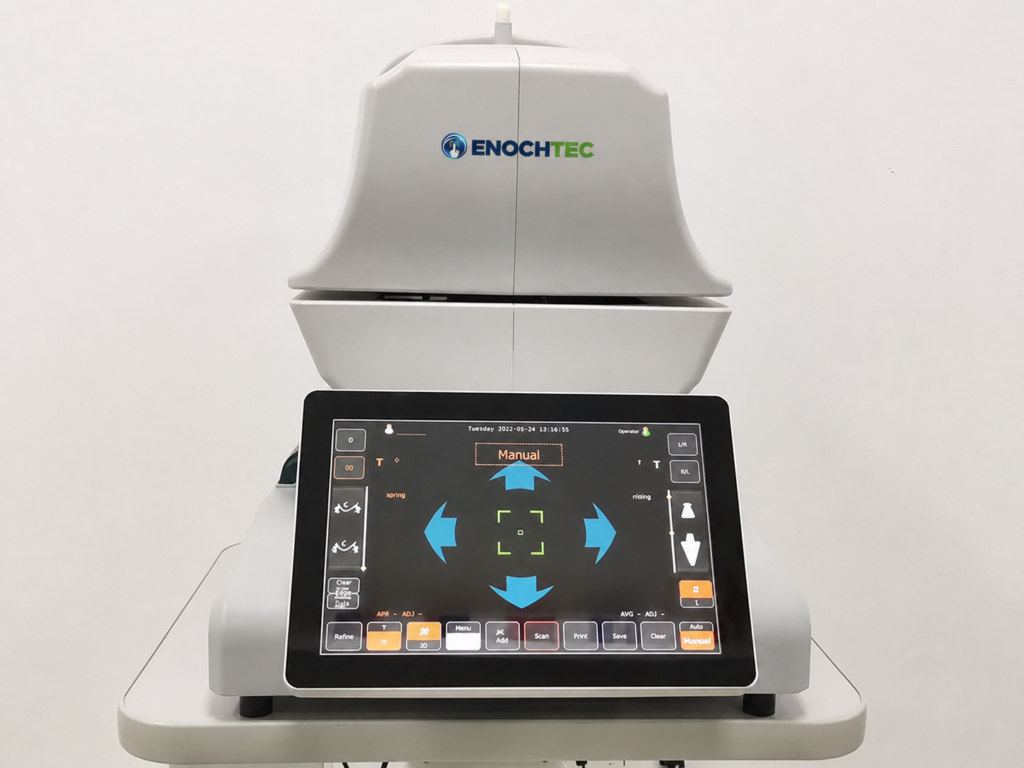
ST-1000P Non-contact Tonometer for Automated IOP Measurement
The ST-1000P non-contact tonometer supports automated intraocular pressure measurement using dual-light and air-pressure sensing. ENOCHTEC offers two related configurations, ST-1000 and ST-1000P, and states that corneal thickness compensation is available on the ST-1000P. A 10.1-inch tiltable touch display and motorized chinrest support operator positioning and review during routine eye-care workflows.
How Does a Non-Contact Tonometer Work?
A non-contact tonometer measures intraocular pressure by directing a short pulse of air at the cornea and detecting, with a light sensor, the moment the cornea is flattened; the higher the pressure inside the eye, the more air force is needed to flatten it. Nothing touches the eye, so no anesthetic drops or disposable probes are needed. The ST-1000P uses this combination of air-pressure and dual-light sensing, with automatic measurement and up to 10 stored readings per eye.
Measurement and Positioning Range
The ST-1000P provides selectable IOP ranges of 1-30 mmHg and 1-60 mmHg. Up to 10 readings can be recorded for each eye, giving the operator several measurements to review within the instrument workflow. The listed working distance is at least 11 mm.
- IOP range: 1-30 mmHg or 1-60 mmHg.
- Stored results: up to 10 readings per eye.
- Working distance: at least 11 mm.
- Front/back travel: at least 30 mm.
- Horizontal/vertical travel: 90 mm / 30 mm.
- Display: 10.1-inch tiltable touch display.
- Patient positioning: motorized chinrest.
ST-1000P and ST-1000 Configuration Boundary
ST-1000 and ST-1000P are variants in the same non-contact tonometer family. The distinction is that corneal thickness compensation is available on the ST-1000P. Other hardware, software, accessories or performance differences should not be assumed unless they are identified in the approved quotation or a current model-specific document.
Corneal thickness compensation is part of the instrument workflow; it is not a diagnosis and does not guarantee a clinical outcome. Measurement results remain subject to professional interpretation together with the wider examination.
What Is Corneal Thickness Compensation?
Corneal thickness compensation adjusts an IOP reading for the patient’s central corneal thickness. Pressure readings from tonometers that flatten the cornea are influenced by how thick it is: a thicker cornea tends to give an artificially high reading and a thinner cornea, for example after refractive surgery, an artificially low one. This function is the feature that distinguishes the ST-1000P from the ST-1000.
Where the ST-1000P Fits
The ST-1000P may be considered for ophthalmology clinics, optometry practices, hospitals and examination rooms that require non-contact IOP measurement. It represents the air-pressure-sensing route within the ENOCHTEC tonometry range and should be kept distinct from a rebound tonometer, because the two product types use different measurement methods and may have different operating and consumable requirements.
Quotation and Installation Checks
The unit uses 220 V / 50 Hz power. Before ordering, confirm the destination-market electrical requirement, selected model, included accessories, patient-table arrangement, documentation language, data or printing requirements and service scope. Items not listed in the specification table should be treated as quotation-dependent rather than standard supply.
ST-1000P Frequently Asked Questions
What is the IOP range?
Selectable ranges are 1-30 mmHg and 1-60 mmHg.
How many readings can the instrument retain?
Up to 10 readings per eye are available.
What distinguishes ST-1000P from ST-1000?
The distinguishing feature is corneal thickness compensation on ST-1000P. Any other difference must be confirmed in the quotation or current model documentation.
Is ST-1000P the same as a rebound tonometer?
No. ST-1000P is presented as an automatic non-contact tonometer using air-pressure sensing. Rebound tonometry is a separate measurement route.
Does a non-contact tonometer touch the eye?
No. The measurement uses a pulse of air and an optical sensor, so there is no contact with the cornea and no anesthetic drops or disposable probes are needed.
Is the air puff painful?
The air pulse is brief and is usually felt as a mild puff rather than pain, although some patients blink or flinch. For patients who find it difficult, a handheld rebound tonometer is another option the clinician may consider.
Why can a non-contact reading differ from a Goldmann reading?
Different tonometers measure pressure in different ways, and readings can also be affected by corneal thickness and patient factors. The clinician interprets the result together with the wider examination and decides whether confirmation with another method is needed.
Review more ophthalmic diagnostic equipment, or contact ENOCHTEC to confirm the ST-1000P configuration for your market and workflow.


