
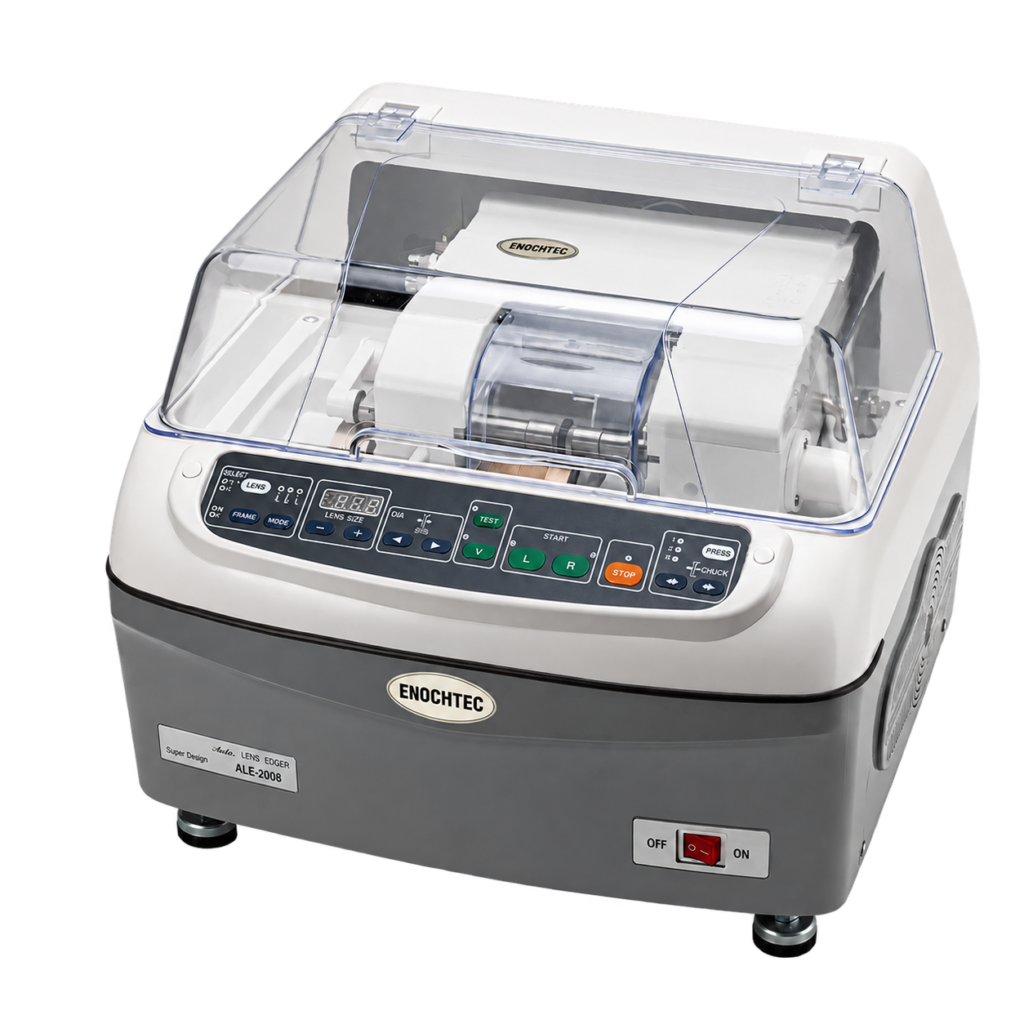
ALE-2008 Automatic Lens Edger for Optical Laboratories
The ALE-2008 automatic lens edger is a template-based lens-finishing system for optical shops and prescription lens laboratories. Its workflow combines automatic pressure clamping, separate processing for mineral-glass and plastic or resin lenses, bevel and flat-edge selection, polishing and automatic re-grinding.
What Does a Lens Edger Do?
A lens edger grinds an uncut spectacle lens down to the shape and size of the frame opening and forms the edge the frame needs: usually a V-bevel for full-rim frames, or a flat edge for rimless and semi-rimless work. In optical shops the same machine is often called a lens edging machine or a lens cutting machine. On the ALE-2008, separate wheels handle plastic or resin lenses, mineral-glass lenses, V-bevel forming and polishing, so one machine covers edging, edge forming and finishing.
Automatic Pressure Clamping
The pressure-clamp system automatically adjusts and tightens the lens in approximately three seconds. The controlled clamping sequence is designed to reduce lens movement during processing and support consistent centering while limiting unnecessary pressure on the lens.
Four-Wheel Grinding and Polishing System
- Dedicated grinding wheels for plastic or resin lenses and mineral-glass lenses.
- Separate wheel for V-bevel forming and re-beveling.
- Dedicated polishing wheel for the finishing stage.
- Selectable bevel and flat-edge processing.
- Trial-edging modes for glass and plastic processing workflows.
- Automatic re-grinding for an additional finishing pass.
Template-Based Sizing and Control
An adjustable template table controls final edging size across a 26–110 mm grinding range. The control panel combines pattern selection, size adjustment, process indicators and an alarm, while the microcomputer controller supports the primary edging and re-grinding functions.
Template-Based vs Tracer-Based Lens Edgers
The ALE-2008 is a template-based edger. The frame shape is transferred to a physical template, and the template controls the lens shape during grinding, with final size set on the template table. Tracer-based, or patternless, edgers read the frame shape digitally and store it as data instead. Template-based machines are mechanically simpler, while tracer-based systems automate shape capture and data handling for higher-volume work. The right choice depends on your daily job count, the frames you fit and your budget.
How the ALE-2008 Edging Workflow Runs
A typical job on the ALE-2008 follows these steps: make the template with the pattern-making unit, mark and center the lens with the centering unit, mount it and let the pressure clamp secure it in about three seconds, select the lens material and a bevel or flat edge, then grind, form the edge and polish. If further finishing is needed, automatic re-grinding runs an additional pass.
Applications
The ALE-2008 is intended for prescription-lens finishing, frame fitting, replacement-lens production and re-edging work in optical shops and optical laboratories. Confirm the exact lens materials, coatings and intended processing workload before ordering.
Accessories and Installation Planning
The supplied accessories comprise a matched working table, operating instructions, electrical cable, adjustment tools, demo driller and centering device. Exact included items are governed by the approved quotation. Buyers should confirm the local voltage and plug, installation space, utilities and required accessory package.
Compare the available automatic lens edgers or contact ENOCHTEC for configuration guidance.
What Affects the Price of a Lens Edger?
The price of a lens edger depends on the complete working setup rather than the main unit alone. For the ALE-2008, the main factors are the supplied accessory package (working table, pattern-making and centering units, tools), the electrical specification for your country (the rated supply is AC 220–240 V), the documentation required for your market, the order quantity and the shipping terms; the machine ships in three cartons for the main unit, base and accessories. Share these details and ENOCHTEC will confirm the configuration and price in a written quotation.
Frequently Asked Questions
Can the ALE-2008 process both glass and plastic lenses?
The wheel system provides dedicated processing for mineral-glass and plastic or resin lenses. Confirm the specific materials and coatings used by your laboratory.
Does it support bevel and flat-edge processing?
Yes. The system provides selectable bevel and flat-edge modes together with re-beveling, polishing and automatic re-grinding functions.
What should be confirmed before quotation?
Provide the lens materials, expected workload, local electrical supply, installation space and required accessories so the final configuration and scope of supply can be confirmed.
Is a lens edger the same as a lens cutting machine?
Yes. In optical shops, “lens cutting machine” and “lens edging machine” usually describe the same job: shaping the lens edge to fit the frame. The ALE-2008 does this by grinding with dedicated wheels rather than by cutting.
Does the ALE-2008 need a frame tracer?
No. It is a template-based edger: the lens shape is controlled by a template, and the specification lists a pattern-making unit and a centering unit for this workflow. Confirm the supply scope in your quotation.
How much space and power does the ALE-2008 need?
The machine measures 500 × 480 × 420 mm with a working height of 750 mm and an overall weight of 60 kg. It runs on AC 220–240 V at approximately 350 W.


