
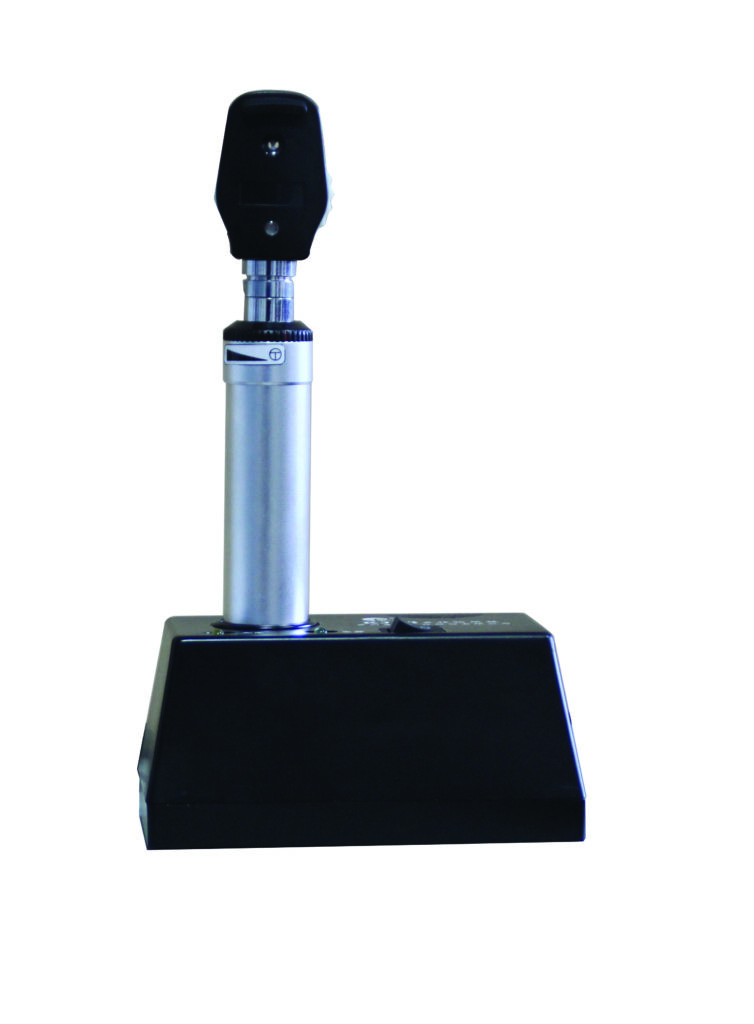
KJ8 Handheld Ophthalmoscope Configurations
The KJ8 handheld ophthalmoscope series supports direct viewing of the ocular fundus during professional eye examinations. The KJ8 Series comprises four configurations: KJ8A1 AC-powered, KJ8B rechargeable, KJ8C dry-cell and KJ8C(Mini) pocket-size dry-cell.
Five Illumination Forms
The KJ8 Series provides a large 3.2 mm light spot, a small 1.6 mm light spot, slit, central-net and red-free illumination. Bulb and power specifications differ by model and should be matched to the selected configuration.
What Are the Apertures and Filters on a Direct Ophthalmoscope For?
Each illumination form on a direct ophthalmoscope is chosen for a specific viewing task. On the KJ8 Series:
- Large light spot (3.2 mm): for a general view of the fundus, especially through a dilated pupil.
- Small light spot (1.6 mm): for a small or undilated pupil, where it reduces reflections from the iris and cornea.
- Slit: for judging surface contour and elevation, for example whether a lesion is raised or depressed.
- Central-net (grid): for estimating the size of a lesion and the distance between features, and for checking fixation.
- Red-free (green) filter: for viewing blood vessels, hemorrhages and the nerve fiber layer, which appear with higher contrast.
Discrete Diopter Compensation
KJ8A1, KJ8B and KJ8C provide the same set of discrete compensation positions from 0 through selected positive and negative powers, including -25 D. KJ8C(Mini) has a shorter selector list and does not include ±5 D or -25 D. These values are selectable positions, not a continuous measuring range.
How Is a Direct Ophthalmoscope Used?
A direct ophthalmoscope gives an upright view of the retina at approximately 15× magnification. In a dimmed room, the examiner looks for the red reflex from about arm’s length, then moves close to the patient, using the right eye to examine the patient’s right eye and the left eye for the left. The lens wheel is turned to bring the retina into focus: it compensates for the refractive error of both patient and examiner, with more plus power for a farsighted eye and more minus power for a nearsighted eye. On the KJ8A1, KJ8B and KJ8C, the wheel runs from +20 D to -25 D in discrete steps.
Selecting a KJ8 Ophthalmoscope
Select KJ8A1 for the AC-powered configuration, KJ8B for rechargeable operation, KJ8C for the larger dry-cell portable option, or KJ8C(Mini) for a smaller pocket-size dry-cell option. KJ8C uses C-size and KJ8C(Mini) uses AA-size dry cells; confirm the battery type for the destination market and all supplied accessories before quotation.
Direct vs Indirect Ophthalmoscope
A direct ophthalmoscope and an indirect ophthalmoscope are used for different parts of the fundus examination. The direct instrument is handheld and portable, shows an upright, highly magnified image and suits a detailed look at the optic disc and macula, but its field of view is small. An indirect ophthalmoscope, used with a handheld condensing lens, gives a wider, stereoscopic but inverted view of the retina and is usually used through a dilated pupil. Many clinics use a direct ophthalmoscope for routine and bedside checks and an indirect system for wide-field retinal examination.
KJ8 Frequently Asked Questions
Is KJ8B rechargeable?
Yes. KJ8B is a lithium-ion rechargeable ophthalmoscope and provides at least 2 hours of continuous operation after a full charge.
Do all KJ8 models have the same diopter positions?
No. KJ8A1, KJ8B and KJ8C share one selector list, while KJ8C(Mini) has a shorter list.
Is a carrying case included?
A case is shown for some configurations, but inclusion varies by configuration and is confirmed in the quotation. Confirm the case, bulbs, batteries, charger and other accessories in the approved quotation.
What is the red-free filter used for?
The red-free (green) filter makes blood vessels, hemorrhages and the nerve fiber layer stand out more clearly against the retina. All KJ8 variants include it.
Which KJ8 model suits outreach or bedside work?
The KJ8B is rechargeable and runs for at least 2 hours after a full charge, while the KJ8C and KJ8C(Mini) run on dry cells (C-size and AA-size) that are easy to replace in the field. The KJ8A1 is AC-powered and suits a fixed examination room.
What magnification does a direct ophthalmoscope give?
A direct ophthalmoscope typically gives an upright image of about 15× magnification, which is why it is useful for detailed views of the optic disc and macula.
Review more diagnostic and imaging equipment, or contact ENOCHTEC to confirm the required KJ8 configuration and supply scope.


