
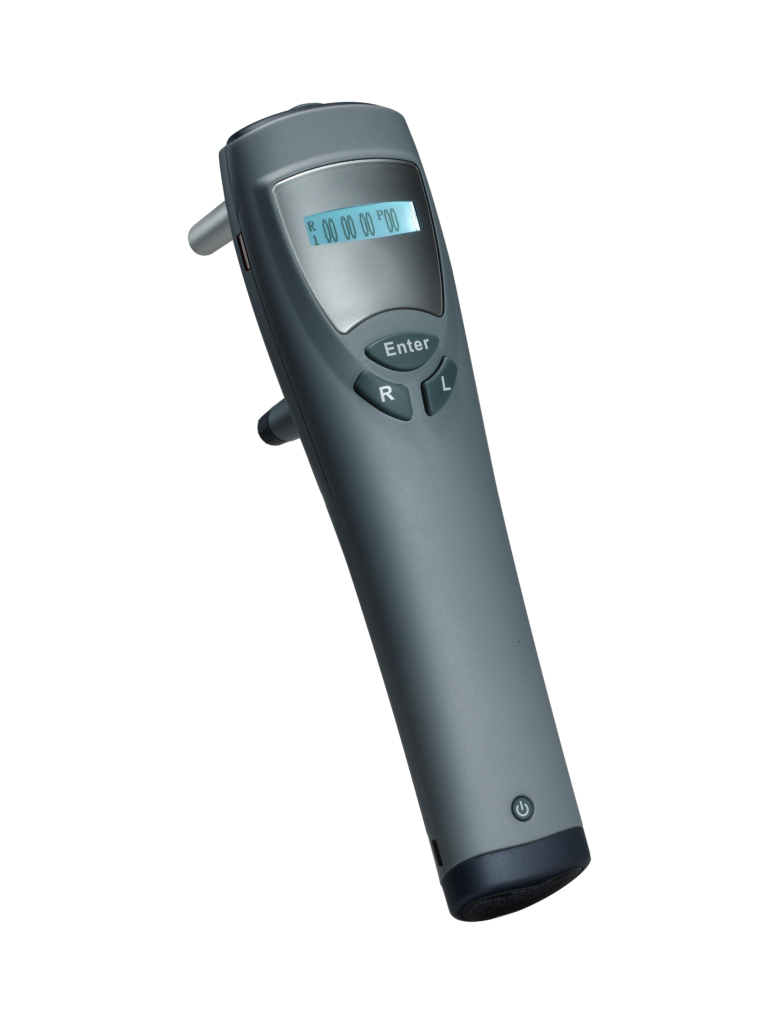
Portable Rebound Tonometry
The RT-500 rebound tonometer is a handheld instrument for measuring intraocular pressure (IOP). Its compact format, disposable-probe workflow and battery power support professional eye-examination settings where flexible instrument positioning is important.
What Is a Rebound Tonometer?
A rebound tonometer measures intraocular pressure by sending a very light, disposable probe briefly against the cornea and recording how quickly it slows down and rebounds: the higher the eye pressure, the faster the probe decelerates. Because the probe touches the cornea only for an instant, rebound measurement is typically performed without anesthetic drops.
Rebound vs Non-Contact vs Goldmann Tonometry
The three common tonometer types differ mainly in how they touch the eye. Goldmann applanation tonometry, performed at the slit lamp with anesthetic and fluorescein drops, is the most widely used clinical method. Non-contact tonometers, such as the ST-1000P, flatten the cornea with a pulse of air and never touch the eye. Rebound tonometers such as the RT-500 are handheld and use a disposable probe that contacts the cornea for an instant, usually without drops. Many clinics keep more than one type and choose by patient and setting.
Measurement Range and Precision
RT-500 measures from 3 to 70 mmHg. Measurement precision is ±1.5 mmHg when IOP is from 3 to 25 mmHg, inclusive, and ±2.5 mmHg when IOP is above 25 mmHg and up to 70 mmHg. Results can be produced in both vertical and horizontal measurement orientations.
Probe and Printer Configuration
The disposable-probe format supports a straightforward measurement workflow. The listed configuration includes 100 disposable probes and one wireless infrared thermal printer for printed result output. Final probe quantity, printer, printer paper, carrying case and other included accessories are confirmed in the approved quotation.
Battery Power and Transport Details
The rated voltage is DC 3 V using two AA batteries. The instrument has a listed net weight of 0.2 kg. Gross weight is 2.9 kg, and the package dimensions are 43.5 × 9.8 × 34.5 cm. These details help buyers plan day-to-day handling, storage and shipment.
When Is a Handheld Rebound Tonometer Useful?
A handheld rebound tonometer is most useful when a patient cannot easily be measured at a table-mounted instrument. Typical situations include children, patients who cannot sit at a slit lamp, bedside checks on wards, outreach and screening work away from the examination room, and patients who find an air puff uncomfortable. The RT-500 measures in both vertical and horizontal orientations, which helps with seated and reclined patients. Whether rebound tonometry is appropriate for an individual patient is decided by the treating clinician.
Professional Use
Rebound measurement is described for use without topical anesthetic drops. The RT-500 should be operated by trained eye-care professionals in accordance with its approved instructions for use and applicable local clinical protocol.
RT-500 Frequently Asked Questions
How does the RT-500 measure intraocular pressure?
It uses rebound tonometry, in which a disposable probe is used during the IOP measurement cycle.
Can measurements be taken in different orientations?
Yes. RT-500 supports both vertical and horizontal measurement.
How are probes supplied?
The listed configuration includes 100 disposable probes. Confirm the required quantity and replenishment supply with the final quotation.
Can RT-500 print results?
Yes. The listed configuration includes one wireless infrared thermal printer. Confirm the printer and consumables included with the order.
Does rebound tonometry need anesthetic eye drops?
Rebound measurement is described for use without topical anesthetic drops. Follow the RT-500 instructions for use and your local clinical protocol.
Are the probes reusable?
No. The RT-500 uses disposable probes, and the listed configuration includes 100. Plan probe replenishment according to your expected number of measurements, and confirm quantities in the quotation.
How do rebound readings compare with Goldmann tonometry?
Rebound tonometry is widely used for measurement and screening, while Goldmann applanation remains the most common clinical method. Readings from different methods can differ, so the clinician decides when a result should be confirmed with another method. The RT-500 precision is ±1.5 mmHg from 3 to 25 mmHg and ±2.5 mmHg above 25 up to 70 mmHg.
View the ophthalmic equipment range, or email ENOCHTEC sales with your market, required quantity and intended workflow.


