
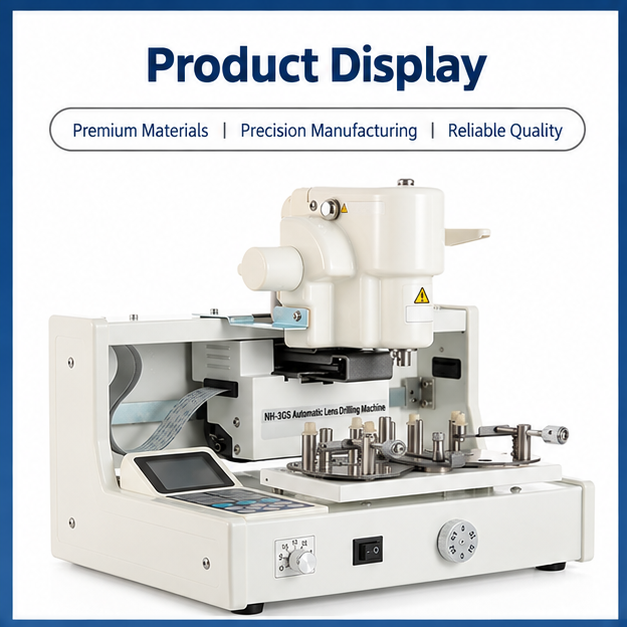
Digital Automatic Lens Drilling for Repeatable Optical Lab Work
The NH-3GS automatic lens drilling machine is designed for repeatable processing of rimless and three-piece lenses in optical laboratories. It combines automated drilling, hole-position memory and on-screen guidance, reproducing hole positions from a reference lens with a deviation of less than 0.075 mm on both the X and Y axes.
What Does a Lens Drilling Machine Do?
A lens drilling machine drills the mounting holes that rimless and three-piece frames need. In these frames the bridge and temples are fixed directly to the lens with screws or plugs, so each hole has to sit exactly where the frame parts expect it; a small error can show up as a tilted lens, a loose fit or a cracked edge. The NH-3GS takes its hole positions from a reference lens and reproduces them with a deviation of less than 0.075 mm on both the X and Y axes.
Accurate Repositioning and Guided Operation
Automatic clamp positioning helps maintain accuracy when lenses are re-clamped. The display shows drilling positions, coordinate data and next-step instructions, helping operators follow the preset sequence and complete missed holes with the corresponding number button.
How Does Reference-Lens Hole Reproduction Work?
On the NH-3GS, the hole positions of a reference lens, such as the demo lens supplied with a rimless frame, are measured and stored in the hole-position memory. The new lens is clamped, and automatic clamp positioning keeps the reference consistent if it has to be re-clamped. The operator then drills in the preset sequence while the display shows the drilling positions, coordinate data and the next step. If a hole is missed, it can be completed with the corresponding number button. Two measurement modes, original pattern and mirrored, cover different drilling layouts.
Manual vs Automatic Lens Drilling
With a manual lens drill, the operator marks the hole positions by hand and relies on skill and jigs to place each hole. An automatic machine such as the NH-3GS measures and stores the positions, guides the sequence on screen and repositions the lens automatically. The result is more repeatable hole placement and less dependence on individual operators, which matters most in laboratories that process rimless jobs every day.
Flexible Pattern Measurement
Original-pattern and mirrored measurement modes support different drilling layouts for rimless and three-piece eyewear production.
What Affects the Price of a Lens Drilling Machine?
The price of a lens drilling machine depends on the complete order rather than the main unit alone. For the NH-3GS, the main factors are the supplied accessories and tools, the documentation required for your market, the order quantity and the shipping terms. The wide 100–240 V AC, 50/60 Hz input suits most destination markets. Many laboratories order a drilling machine together with an edger, such as the ALE-2008, and a groover for semi-rimless work. Share your requirements and ENOCHTEC will confirm the configuration and price in a written quotation.
Lens Drilling Machine Questions
Which frames need drilled lenses?
Rimless and three-piece frames, where the bridge and temples are attached to the lens through drilled holes. Semi-rimless frames usually hold the lens with a nylon line in a groove instead, which is cut with a lens groover rather than a drill.
How accurate is the NH-3GS?
Compared with the reference lens, the NH-3GS reproduces hole positions with a deviation of less than 0.075 mm on both the X and Y axes.
How much space and power does the NH-3GS need?
The machine measures 302 × 228 × 270 mm and weighs 5 kg. It accepts 100–240 V AC at 50/60 Hz, runs internally on DC 24 V and has a rated power of 50 W.


