
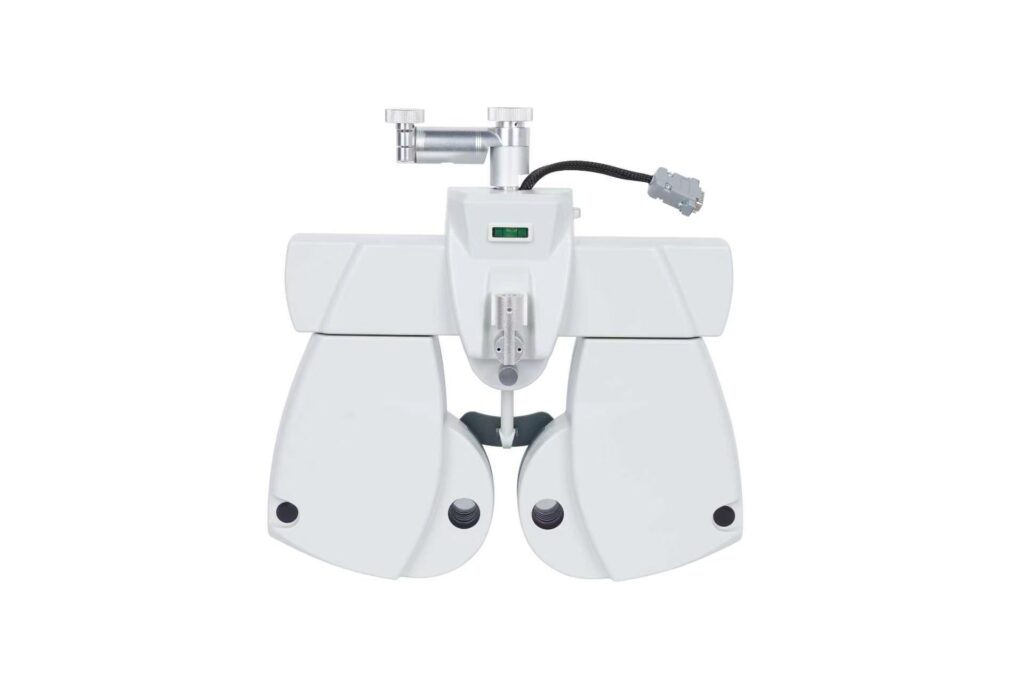
CV-5600 Auto Phoropter for Digital Refraction
The CV-5600 auto phoropter combines an electrically controlled phoropter head with a 10.2-inch touch-panel controller for subjective refraction workflows. The CV-5600 combines a quiet mechanism with a simple interface and quick entry of sphere, cylinder, axis and addition values. These characteristics make the system suitable for optometry clinics, ophthalmology practices, hospitals and refraction rooms that want a structured digital alternative to repeated manual lens changes.
What Is an Auto Phoropter?
An auto phoropter is a refractor head whose lenses are changed by motors, controlled from a panel, instead of being turned by hand at the patient’s face. It is used for subjective refraction: the patient compares lens options while the examiner refines sphere, cylinder, axis and near addition. The same instrument is also called a digital phoropter, an electronic phoropter or an automated refractor. On the CV-5600, the examiner works from a 10.2-inch touch-panel controller.
Measuring Range
The CV-5600 covers a negative sphere range from 0.00 D to −19.00 D and a positive range from +0.25 D to +16.50 D, with selectable 0.25 D, 0.50 D, 1.00 D and 3.00 D steps. Cylinder covers 0.00 D to −8.75 D in 0.25 D steps. Axis covers 0°–180° with 1° or 5° steps, while pupillary distance covers 48–80 mm in 1 mm steps.
- Auto cross-cylinder lens: ±0.25 D.
- Fixed cross cylinder: ±0.50 D.
- Rotary prism: 0△–20△ with 0.1△, 0.5△ or 1△ steps.
- Retinoscopy lens: +1.50 D.
- Quick input: SPH, CYL, AXIS and ADD values.
Auxiliary Lenses and Test Functions
The auxiliary set includes an occluder, PD check, 1 mm pinhole plate, polarizing filters positioned at 135° for the right eye and 45° for the left eye, red/green filters, Maddox rods and dissociation prisms. The system provides a 6△ base-up prism for the right eye and a 10△ base-in prism for the left eye. Final supplied accessories should be matched to the approved quotation.
Designed for an Efficient Refraction Workflow
- 10.2-inch touch-panel monitor with a visual control interface.
- Quiet operating design for patient-facing examination rooms.
- Quick digital entry of core refraction values.
- Sphere, cylinder, axis, PD, prism and auxiliary-lens functions in one system.
For distributors and project buyers, the CV-5600 can serve as the subjective-refraction component of a wider room configuration. Visual-acuity displays, auto refractors or keratometers, workstations, examination chairs, mounting hardware and cables are separate project items unless they are specified in the approved quotation.
Auto Phoropter vs Manual Phoropter
Both types hold the same kinds of lenses in front of the patient; the difference is how the lenses are changed. A manual phoropter, such as the FO-600, is operated by turning dials on the head, needs no power and costs less. An auto phoropter changes lenses from a controller, which allows quick entry of sphere, cylinder, axis and addition values, faster lens changes during comparisons and less reaching across the patient. The CV-5600 is also designed to run quietly in patient-facing rooms.
How Is Subjective Refraction Done with an Auto Phoropter?
A typical subjective refraction starts from an objective result, often from an auto refractor such as the ARK-710, and then refines it step by step:
- Sphere: the best spherical correction is found for each eye.
- Cylinder: axis and power are refined with the cross-cylinder; the CV-5600 has an auto cross-cylinder lens of ±0.25 D and a fixed cross cylinder of ±0.50 D.
- Red-green check: the red/green filters help confirm the spherical end point.
- Binocular balance: the dissociation prisms (6△ base up for the right eye, 10△ base in for the left) or polarizing filters let the examiner compare both eyes.
- Near addition: the ADD value is set for near vision where needed.
The exact sequence and end points are decided by the examining optometrist or ophthalmologist.
What to Confirm Before Ordering
Buyers should confirm the destination market, mounting arrangement, power requirement, accessory list, supporting instruments and any tender or regulatory documents needed. The final quotation should identify the phoropter head, controller, mounting parts and every included auxiliary item so that the delivered configuration matches the intended refraction workflow.
What Affects the Price of an Auto Phoropter?
The price of an auto phoropter depends on the complete refraction setup rather than the head alone. For the CV-5600, the main factors are the mounting arrangement and arm, the accessory list, any supporting instruments such as a visual-acuity display or auto refractor, the power standard for your country, the documentation required for your market, the order quantity and the shipping terms. Share these details and ENOCHTEC will confirm the configuration and price in a written quotation.
CV-5600 Frequently Asked Questions
What controller is supplied with the CV-5600?
A 10.2-inch touch-panel monitor is used to enter and control refraction values.
What is the sphere range?
Sphere covers 0.00 D to −19.00 D and +0.25 D to +16.50 D, with selectable 0.25 D, 0.50 D, 1.00 D and 3.00 D steps.
Is an auto phoropter the same as a digital phoropter?
Yes. Auto phoropter, digital phoropter and electronic phoropter are different names for a phoropter whose lenses are changed by motors from a controller.
Does the CV-5600 replace an auto refractor?
No. An auto refractor gives an objective starting point, while the CV-5600 is used to refine the prescription subjectively with the patient’s responses. Most refraction rooms use both.
What cross-cylinder and prism options does the CV-5600 have?
It has an auto cross-cylinder lens of ±0.25 D, a fixed cross cylinder of ±0.50 D and a rotary prism from 0△ to 20△ in 0.1△, 0.5△ and 1△ steps.
Explore more ophthalmic and optometry equipment, or contact ENOCHTEC to review a coordinated refraction-room configuration.


