
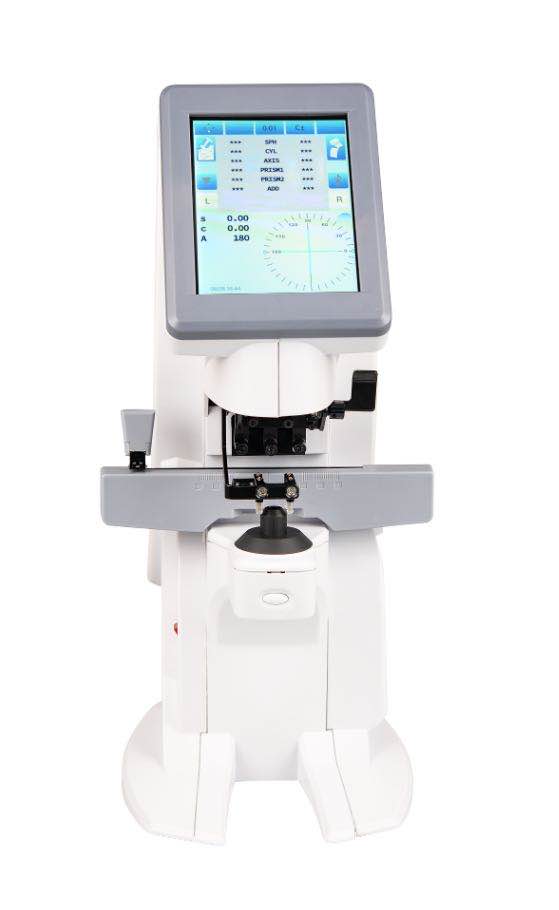
HV-300 Automatic Lensmeter for Prescription Lens Verification
The ENOCHTEC HV-300 auto lensmeter provides rapid analysis of single-vision and progressive lenses through a capacitive touchscreen interface. In addition to sphere, cylinder, axis and prism measurement, it can assess visible-light, UV and blue-light transmittance for optical dispensing, laboratory quality control and incoming-lens inspection.
What Is an Automatic Lensmeter?
An automatic lensmeter measures the power of spectacle lenses electronically: sphere, cylinder, axis and prism, without the operator focusing a target by eye. The same instrument is also called a lensometer, a focimeter or a lens analyzer. Compared with a manual lensmeter, an automatic model is faster and less dependent on operator skill, and it can add functions such as progressive-lens recognition, transmittance checks and data output. On the HV-300, sphere is measured from -40.00 D to +25.00 D and cylinder up to ±10.00 D.
Lens Analysis Features
- Automatic recognition of progressive and single-vision lenses.
- Sphere measurement from -40.00 D to +25.00 D.
- Cylinder measurement from 0.00 D to ±10.00 D.
- Selectable 0.01, 0.12 and 0.25 D measurement steps.
- Prism measurement from 0 to 10 prism diopters.
- Integrated UV and blue-light transmittance checks at 400 nm and 425 nm.
Applications in Optical Shops and Laboratories
The HV-300 can support verification of finished spectacles, checking of uncut lenses and quality-control processes before dispensing. Progressive-lens recognition helps operators locate and evaluate multifocal designs, while fine selectable measurement steps allow the display format to match the practice or laboratory workflow.
Why Offer More Than One Lensmeter?
Different lensmeter models can remain useful within the ENOCHTEC portfolio because buyers may prioritize different screen layouts, automation levels, wavelength functions, measurement ranges or physical designs. The HV-300 is positioned as a touchscreen analyzer with additional transmittance measurement rather than as the only option for every customer.
What Should Buyers Compare?
When selecting an automatic lensmeter, compare the sphere and cylinder ranges, prism capability, progressive-lens workflow, selectable step size, UV or blue-light functions, marking method, printer and connectivity options, counter footprint and operator interface. The best choice depends on the type and daily volume of lenses being verified.
What Affects the Price of an Automatic Lensmeter?
The price of an automatic lensmeter depends on the functions and options you need rather than the base unit alone. For the HV-300, the main factors are configuration-dependent options such as thermal printing and PD measurement, the data connection you plan to use (RS232 or Bluetooth), the power and plug standard for your country, the documentation required for your market, the order quantity and the shipping terms. Share these details and ENOCHTEC will confirm the configuration and price in a written quotation.
Does the HV-300 Support Data Transfer and Printing?
The HV-300 supports RS232 and Bluetooth data transfer using BLE and SPP protocols. Confirm compatibility with the intended receiving device or software before ordering. Thermal printing and PD measurement are configuration-dependent options and should be confirmed in the quotation.
Automatic Lensmeter Questions
Is a lensmeter the same as a lensometer or focimeter?
Yes. Lensmeter, lensometer and focimeter are different names for the instrument that measures the power of spectacle lenses. “Lens analyzer” is often used for automatic models with extra functions, such as the HV-300.
Can the HV-300 measure progressive lenses?
Yes. The HV-300 automatically recognizes progressive and single-vision lenses, which helps operators locate and evaluate multifocal designs.
What do the 400 nm and 425 nm readings show?
They are transmittance checks: they indicate how much light at 400 nm, at the edge of the ultraviolet range, and at 425 nm, in the blue-light range, passes through the lens. They help verify lenses sold with UV or blue-light filtering.
Request a Lens-Analysis Recommendation
Tell ENOCHTEC whether the instrument will be used at a dispensing counter, central laboratory, training center or production-quality station. We can compare the HV-300 with other lensmeter options and recommend a suitable optical-lab configuration.


