
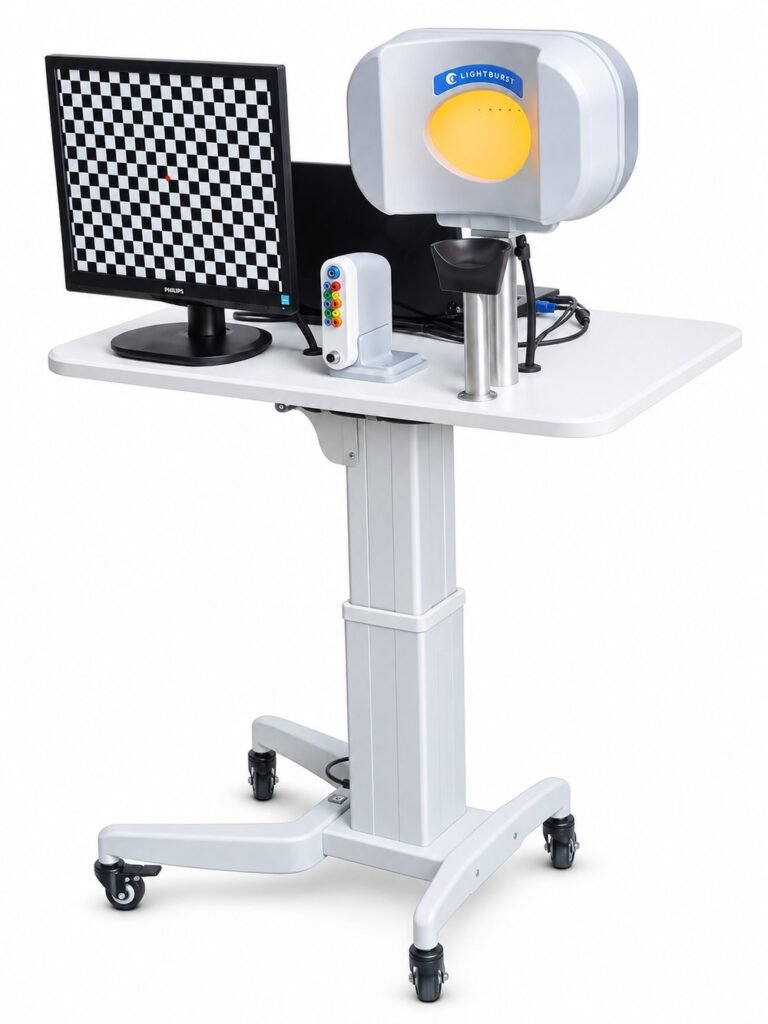
RetiMINER-C Mobile ERG, VEP and EOG System
The ENOCHTEC RetiMINER-C is a mobile ERG and VEP system built around a battery-powered DC amplifier and a LightBurst flash stimulator, with the computer, stimulators and amplifier on one movable motorized table. It performs pattern VEP, flash VEP, pattern ERG, flash ERG and EOG, plus special ERG protocols, and can be moved to the bedside for subjects who are seated, lying down, or are infants. Animal testing is available as an option.
Related models: RetiMINER-P Visual Electrophysiology System · RetiMINER Animal ERG and VEP System
Why Choose a Mobile Electrophysiology System?
Patients who cannot sit at a fixed device, such as infants and bed-bound patients, need the equipment to come to them. The LightBurst flash stimulator weighs less than 3 kg and can also be taken down to test lying patients and infants, while the amplifier connects through an optically isolated USB link and runs from a rechargeable lithium-ion battery. The computer, stimulators and amplifier share one movable motorized table, which makes bedside testing possible.
GIMAmp DC Amplifier
The GIMAmp amplifier has a 24-bit A/D converter, an optically isolated USB connection and a lithium-ion battery, with two channels as standard and five or eight channels as options. Because it records the full-band DC signal, filters are applied digitally in the software.
LightBurst Flash Stimulator
- 18 groups of background and stimulus light in white, red, blue, green and yellow, with infrared and ultraviolet as options.
- Flash intensity of 100 cd·s/m² in under 4 ms, with a flash range of 0–1000 and a background of 0–3000 cd/m².
- Stimulus frequency of 0.01–200 Hz.
- 11 fixation and EOG indicators with 64 adjustable intensity levels, and a ±25° EOG saccade range.
- Infrared camera for monitoring during the test.
Pattern Stimulator
The LCD pattern stimulator provides checkerboard, horizontal and vertical stripes and rectangle patterns with reversal, on/off and string stimulation, luminance of 0–200 cd/m² and contrast above 98% for pattern VEP and pattern ERG. The fixation target and stimulus field can be adjusted, and a low-vision fixation target is available. Hexagon and dartboard patterns are not available on the LCD stimulator.
Test Programs
The software includes PVEP, FVEP, PERG, FERG and EOG, together with S-Cone ERG, PhNR, Double Flash ERG and On/Off ERG protocols. An administrator (password login) can define user programs, such as special procedures for animal tests, while the routine human clinical programs stay unchanged. Utilities such as a dark and light adaptation timer and a dark-red illumination and screen mode support work in a darkroom.
Offline Averaging and Signal Processing
Recordings can be reviewed after the test: sweeps contaminated by eye or muscle movement can be rejected manually, new filters can be defined and the signal can be analysed in the frequency domain.
VEP Electrode Set
A dedicated VEP electrode set simplifies the setup: one bridge electrode as the active electrode, one ear clip as ground and one disc electrode as reference.
Animal Test (Optional)
The RetiMINER-C can be equipped for animal research. The optional animal test set contains animal electrodes (gold or silver thread cornea electrode, needle, ear clip and disc electrode) and an infrared camera that continuously monitors the animal and the electrode setup. The LightBurst stimulator supports testing of dogs, monkeys, pigs, mice, rats and rabbits, and an optional animal platform with a rotating electrode clip fixes the electrode at any angle for mice, rats, rabbits and other small animals. For a dedicated animal research system, see the RetiMINER Animal ERG and VEP System.
Upgrade Path to mfERG and VEP
The RetiMINER-C can be upgraded for multifocal ERG and multifocal VEP by replacing the LCD with a LightCube pattern stimulator and upgrading the software. Please ask for the upgrade configuration when requesting a quotation.
RetiMINER Models
| RetiMINER-P | RetiMINER-C | RetiMINER Animal | |
|---|---|---|---|
| Intended use | Clinical ERG, VEP and EOG | Clinical and research ERG, VEP and EOG | Animal ERG and VEP research |
| Design | All-in-one host | Separate stimulators on a movable motorized table | Animal platform with 90° cantilever flash stimulator |
| Flash stimulator | Built-in, 30 cd·s/m² | LightBurst, 100 cd·s/m² | LightBurst, 100 cd·s/m² |
| Pattern stimulator | Built-in | LCD | Optional |
| Test position | Single fixed position | Seated, lying or infant subjects; bedside use possible | Animal on the platform |
| Animal testing | — | Optional add-on | Dedicated system |
What Should Buyers Confirm Before Ordering?
Confirm the tests required, the number of amplifier channels (2, 5 or 8), whether infrared or ultraviolet stimulation is needed, the electrode sets, whether the optional animal test set and animal platform are required, and the intended upgrade to mfERG and VEP. The final supply configuration is confirmed in the written quotation. Request a quotation for the RetiMINER-C
Frequently Asked Questions
Can the RetiMINER-C test infants and bed-bound patients?
Yes. The battery-powered amplifier and the LightBurst flash stimulator, which can also be taken down for lying patients and infants, are designed for seated, lying and infant subjects, and the motorized table moves the system to the bedside.
Which tests does it run?
Pattern VEP, flash VEP, pattern ERG, flash ERG and EOG, plus S-Cone ERG, PhNR, Double Flash ERG and On/Off ERG, and user-defined programs.
Can it be upgraded later?
Yes. Replacing the LCD with a LightCube pattern stimulator and upgrading the software adds multifocal ERG and VEP.
Can the RetiMINER-C be used for animal research?
Yes, as an option. An animal test set (animal electrodes and an infrared camera) and an animal platform for mice, rats and rabbits can be added. For dedicated animal studies see the RetiMINER Animal ERG and VEP System.
How does it differ from the RetiMINER-P?
The RetiMINER-P is an all-in-one host for a fixed test position, while the RetiMINER-C separates the stimulators so they can be moved to the patient. See the RetiMINER-P page.
See the Visual Electrophysiology range for related systems. Interpretation of results remains the responsibility of the examining clinician.