
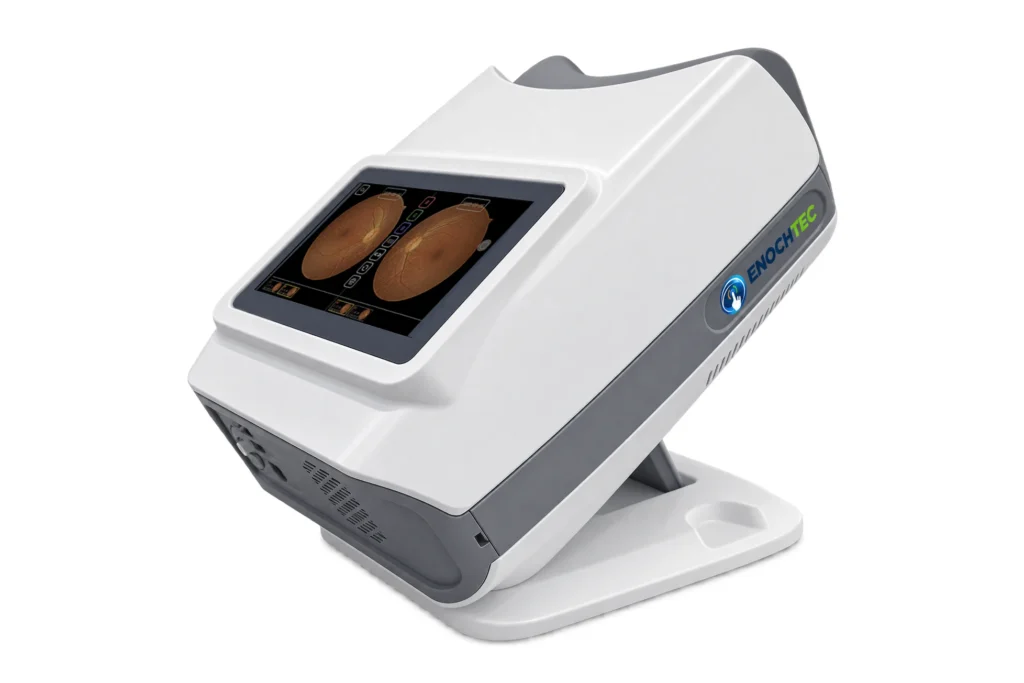
Portable Fundus Screening with One-Touch Automatic Capture
The Kestrel 300 portable automatic fundus camera brings 20-megapixel, 50° fundus photography to screening programs outside the eye clinic. The instrument tracks the pupil, focuses and switches between eyes automatically, and full voice guidance leads the examinee through the test, so a non-mydriatic examination of both eyes can be completed in about 30 seconds without specialist operators.
Automatic Operation with Voice Guidance
After patient registration, one touch starts the capture. The camera aligns to the pupil, focuses, takes the image and moves to the other eye on its own, while voice prompts tell the examinee what to do. Automatic and manual modes are both available for focus, exposure and operation, and a dual-camera system assists autofocus.
- Automatic pupil tracking, autofocus and automatic left/right eye switching.
- Full voice navigation for self-guided examinations.
- Automatic or manual focus, exposure and operation.
- Internal fixation target.
20 MP Imaging Through Small Pupils
A 20-megapixel CMOS sensor and a 50° field of view capture the posterior pole in high definition, with central-field resolution of at least 60 lp/mm. The minimum pupil size is 3.0 mm, the working distance is 15 mm and diopter compensation covers ±15 D. Non-mydriatic and mydriatic acquisition modes are both listed.
Built to Move Between Sites
The camera weighs 3.6 kg and measures 284 × 306 × 145 mm (L × W × H). An HD touchscreen display, a multi-angle stand and a fitted carrying case make it practical for mobile screening, bedside examinations and outreach work. It runs on 100-240 V, 50/60 Hz.
Connected Screening Workflow
DICOM 3.0 is supported for connection to image-management systems, and a customizable AI interface allows images to be passed to AI reading or cloud services. AI software, cloud services and their regulatory status are not assumed included and must be confirmed in the quotation.
Where the Kestrel 300 Fits
The Kestrel 300 is designed for fundus screening where a full desktop camera is impractical: primary care centers, community clinics, physical examination institutions, in-hospital bedside examinations, optometry centers and optical shops, elderly care institutions, public health programs, research projects and insurance health checks.
Kestrel 300 or RetiCam 3100?
Both are ENOCHTEC non-mydriatic fundus cameras with a 50° field. They differ in format and imaging details.
| Item | Kestrel 300 | RetiCam 3100 |
|---|---|---|
| Format | Portable, 3.6 kg, with carrying case | Desktop workstation, 26.5 kg |
| Camera | 20 MP CMOS | SLR camera photography (24 MP) |
| Minimum pupil | ≥3.0 mm | ≥3.3 mm |
| Diopter compensation | ±15 D | ±25 D |
| Wider coverage | Single 50° images | Up to 135° from a nine-image mosaic |
- Choose the Kestrel 300 for screening programs, mobile and bedside use, and sites where examinees are guided by voice without a specialist operator.
- Choose the RetiCam 3100 for a fixed clinic workstation that needs mosaic imaging and a wider diopter range.
Kestrel 300 Questions Before Ordering
Does every examination avoid dilation?
The camera is designed for non-mydriatic capture with a minimum pupil size of 3.0 mm, and a mydriatic mode is also listed. The clinician decides the appropriate preparation and whether an image is adequate for the intended examination.
Can examinees use it without an operator?
Voice navigation and automatic alignment, focus and eye switching are designed for self-guided capture. Site staff should still register patients, supervise use and review image quality.
Is AI reading included?
A customizable AI interface is listed. AI reading software, cloud services, licences and regulatory clearance are not assumed included and must be confirmed in the quotation.
What power supply does it use?
The listed supply is 100-240 V, 50/60 Hz. Confirm the plug and destination-market documentation in the quotation.
Request a Kestrel 300 Configuration
Contact ENOCHTEC sales with your country, quantity, screening setting and image-management requirements. Confirm the current model-specific specification, carrying case, software, accessories, training, service and destination-market documentation in the quotation. Specifications and design are subject to change.