
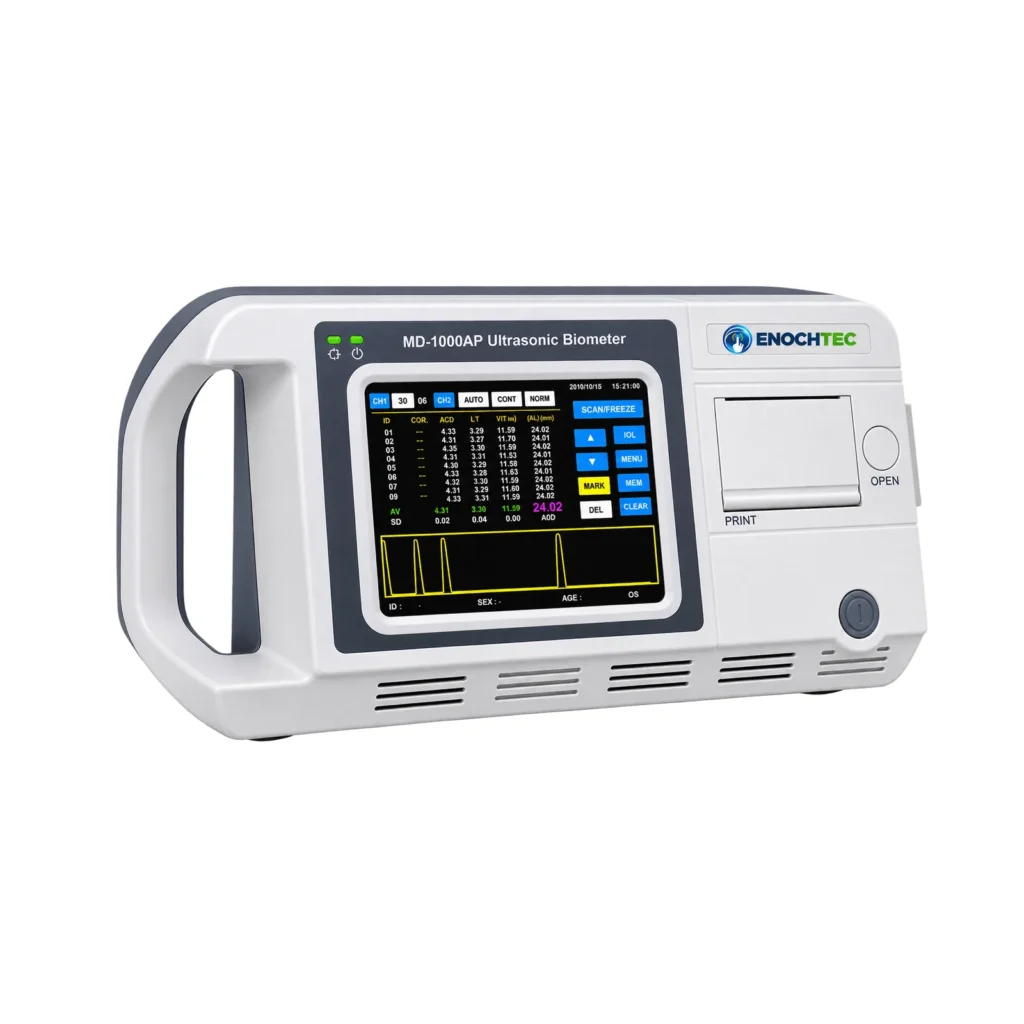
MD-1000 Series Ultrasonic A-Scan Biometer and Pachymeter
The ENOCHTEC MD-1000 series is a portable ultrasonic A-scan biometer and pachymeter for ophthalmology. The MD-1000A measures axial length and calculates IOL power, the MD-1000P measures corneal thickness, and the MD-1000A/P combines both functions in one 1.7 kg touchscreen unit with a footswitch and a built-in thermal printer.
Which MD-1000 Configuration Do You Need?
All three models share the same console, display, printer and dimensions. They differ in the measurement functions and probes supplied:
| Function / item | MD-1000A | MD-1000P | MD-1000A/P |
|---|---|---|---|
| A-scan biometry (AL, ACD, lens thickness, vitreous length) | ✓ | — | ✓ |
| IOL calculation (6 formulas + 5 post-refractive methods) | ✓ | — | ✓ |
| Corneal pachymetry | — | ✓ | ✓ |
| 10 MHz A-probe with red fixation light | ✓ | — | ✓ |
| 20 MHz pachymetry probe | — | ✓ | ✓ |
| Typical use | Cataract biometry | Refractive surgery screening, IOP interpretation | Both workflows in one unit |
A-Scan Biometry for Cataract Surgery Planning
The 10 MHz A-scan probe measures anterior chamber depth, lens thickness, vitreous length and axial length in contact or immersion mode (the immersion shell is an optional accessory). Automatic measurement is available for four eye types — normal, cataract, aphakic and special — and a manual mode is provided for difficult eyes. Readings are grouped with the average and standard deviation shown on screen, so inconsistent measurements are easy to spot before the result is used.
- Biometry accuracy ±0.05 mm, resolution 0.01 mm, measuring range 15–40 mm.
- Total gain 100 dB with an adjustable range of 0–50 dB, plus automatic gain control.
- Touch screen and footswitch for hands-free capture during probe placement.
IOL Power Calculation, Including Post-Refractive Eyes
Six IOL formulas are built in: SRK-II, SRK-T, Binkhorst-II, Holladay, Hoffer-Q and Haigis. For eyes after corneal refractive surgery, five post-refractive methods are available: history-derived, double-K/SRK-T, refraction-derived, Rosa and Shammas. The measured axial length is transferred to the IOL screen automatically, two formulas can be displayed side by side for comparison, and the result prints with a single touch.
IOL calculation also needs keratometry (K) readings, which are entered from a keratometer or an auto refractor keratometer such as the ARK-8900 or RMK-8100.
Ultrasonic Pachymetry and IOP Adjustment
The 15–20 MHz pachymetry probe measures corneal thickness from 230 to 1200 μm with ±5 μm accuracy and 1 μm display resolution. Readings can be taken at a single point or at multiple points, and repeated measurements at one point are averaged for higher reliability. Multiple corneal maps are shown graphically.
Corneal thickness influences applanation and non-contact tonometry readings. The MD-1000P and MD-1000A/P include an IOP adjustment function that provides a corneal-thickness reference for tonometer results, for example from the ST-1000P non-contact tonometer or the RT-500 rebound tonometer. Clinical interpretation remains the responsibility of the examining clinician.
Where the MD-1000 Fits in the Cataract Workflow
- Keratometry — K readings from the ARK-8900 auto refractor keratometer.
- Axial length — A-scan biometry with the MD-1000A or MD-1000A/P.
- IOL power — calculated on the MD-1000 with the selected formula and printed for the surgical record.
- Surgery — phacoemulsification with the MD-480A phaco system under an SM-3000L ophthalmic surgical microscope.
ENOCHTEC can quote these items together for a new cataract service. Request a cataract equipment package quote.
MD-1000 vs Enochview-1000 vs AL-VIEW Lite
| MD-1000 series | Enochview-1000 | AL-VIEW Lite | |
|---|---|---|---|
| Principle | A-scan ultrasound | A-scan + B-scan ultrasound | Optical biometry (OLCR) |
| Contact with the eye | Contact or immersion | Contact | Non-contact |
| Corneal pachymetry | Yes (P and A/P models) | No | Optical CCT |
| B-scan imaging | No | Yes | No |
| Dense cataract / opaque media | Measurable | Measurable | May not be measurable |
| Format | Portable, 1.7 kg | Workstation | Tabletop |
Choose the MD-1000 for dedicated, portable ultrasound biometry and pachymetry at a lower investment; the Enochview-1000 when B-scan imaging of the posterior segment is also required; and the AL-VIEW Lite for non-contact optical biometry in eyes with clear media. Many cataract services keep ultrasound biometry alongside an optical biometer for eyes that optical devices cannot measure.
Data Management and Printing
The unit stores up to 180 patient records. Acoustic velocities, IOP parameters and print-out content can be defined by the user, and the built-in thermal printer produces results with a single touch.
What Should Buyers Confirm Before Ordering?
Confirm the model (A, P or A/P), the pachymetry probe type (straight or angled), whether the optional immersion shell is required, printer paper supply, interface language, local power standard and destination-market documentation. Review the Ophthalmic Ultrasound & Biometry range for related equipment. The final supply configuration is confirmed in the written quotation.
What Affects the Price of an A-Scan Biometer or Pachymeter?
The quoted price depends on the configuration — A-scan only, pachymeter only or the combined A/P model — together with probe options, the immersion shell, spare probes and consumables, documentation for the destination market and shipping terms. Including these points in your enquiry allows an accurate, comparable quotation.
Frequently Asked Questions
What is the difference between the MD-1000A, MD-1000P and MD-1000A/P?
The MD-1000A is an A-scan biometer with IOL calculation, the MD-1000P is an ultrasonic pachymeter, and the MD-1000A/P combines both functions with both probes in one unit.
Does the MD-1000 support immersion biometry?
Yes. The A-scan works in contact and immersion modes; the immersion shell is supplied as an optional accessory.
Which IOL formulas are included?
SRK-II, SRK-T, Binkhorst-II, Holladay, Hoffer-Q and Haigis, plus five post-refractive methods: history-derived, double-K/SRK-T, refraction-derived, Rosa and Shammas.
Why measure corneal thickness?
Corneal thickness is checked before corneal refractive surgery and helps interpret tonometry readings, because thinner or thicker corneas can make measured IOP read lower or higher. The MD-1000P and MD-1000A/P provide an IOP adjustment reference.
How does the MD-1000 differ from the Enochview-1000 A/B scanner?
The MD-1000 is a dedicated, portable A-scan biometer and pachymeter. The Enochview-1000 adds B-scan imaging of the vitreous and retina but does not include pachymetry.
Can the MD-1000 replace an optical biometer?
The two methods complement each other. Optical biometry is non-contact but needs clear media; ultrasound A-scan can still measure axial length through a dense cataract or other opacities.
What power supply does it need?
AC 100–240 V, 50/60 Hz, 50 VA, so the same unit can be used on 110 V and 220 V mains.