C10 AI Vision Screener for Binocular Refractive Screening
The C10 AI vision screener is a portable device for preliminary binocular refractive-state screening. From a nominal measuring distance of 100 cm (±5 cm), it collects sphere, cylinder, axis and pupillary-distance values for both eyes in under 15 seconds.
Screening Outputs
The C10 reports the following refractive-screening values for both eyes. Results are intended to support screening and referral workflows; they do not replace a complete refraction, diagnosis or comprehensive eye examination.
- Spherical power: -8.00 D to +8.00 D (±0.25 D).
- Cylindrical power: -3.50 D to +3.50 D (±0.25 D).
- Axis: 0–180°.
- Pupillary distance (PD).
One-Meter Screening Workflow
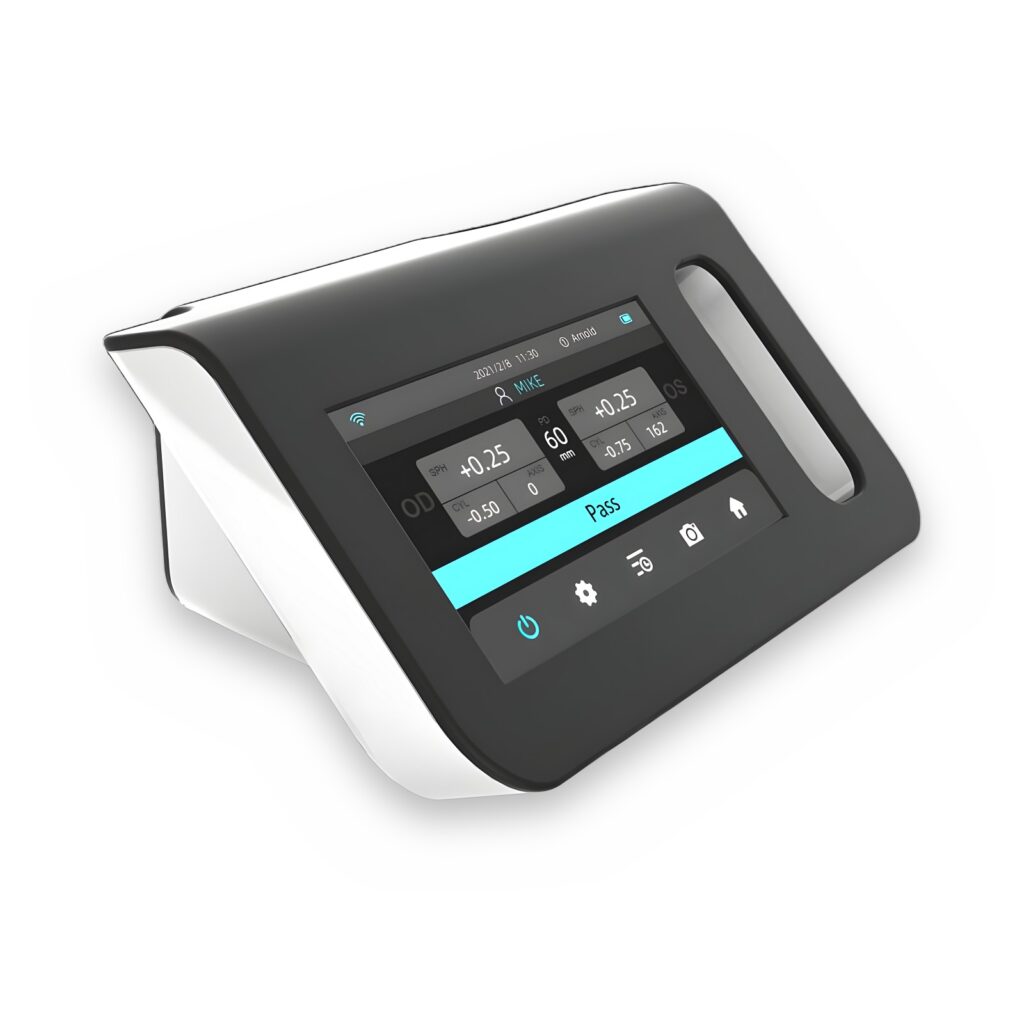
The operator enters a name or ID, gender and date of birth on the touchscreen, then holds the C10 approximately one metre from the subject and aligns both eyes in the live infrared view. A short countdown starts the automatic capture, and the result appears in under 15 seconds: sphere, cylinder and axis for each eye, the pupillary distance, and a Pass or Refer indication that helps decide who should be referred for a full eye examination.
Cloud-Based AI Processing
The C10 uses a deep-learning model to analyse the captured eye images. Images are sent over Wi-Fi to a cloud server, which calculates the result and returns it to the device, so an internet connection is required during screening. According to the manufacturer, no sensitive personal data is required, and captured eye images are used only to compute the result and are not stored. Confirm network availability and local data-protection requirements before deployment.
Comfortable Screening for Children
Screening uses invisible infrared light with no bright flash, is contactless and is completed from a distance of about one metre in a few seconds. This makes the C10 practical for preschool children and other subjects who may not cooperate with a conventional autorefractor.
No Routine Maintenance or Calibration
The C10 does not require routine maintenance or user calibration. After use, it can simply be stored in its original box.
Portable Hardware and Connectivity
A 7-inch 1080P LCD touchscreen provides the operating interface. Connectivity includes Wi-Fi 6 (802.11ax) and a USB 3.0 charging port, with a five-hour battery rating. Power input is 100–240 V, 50/60 Hz, 35 VA, with a 5 V, 2 A charger output.
C10 Screening Workflow Video
Applications
The C10 supports preliminary binocular refractive screening where sphere, cylinder, axis and PD values are needed at an approximately one-metre working distance. Typical users include optometrists, ophthalmologists, optical stores, school and public-health screening programmes, and distributors of ophthalmic equipment. Final suitability, operator requirements and referral procedures should be determined for the intended market and setting.
If results must be calculated on the device without an internet connection, see the CVS X pediatric photoscreener. For how screeners compare with tabletop autorefractors, read Photoscreener vs Autorefractor.
Frequently Asked Questions
Is the C10 a diagnostic device or prescription instrument?
The C10 is a vision screener that provides preliminary refractive-state values. It is not a substitute for a complete subjective refraction, diagnosis or comprehensive eye examination.
What values does it provide?
The outputs are sphere, cylinder, axis and pupillary distance for both eyes.
How far is the device positioned from the subject?
The measuring distance is 100 cm with a ±5 cm allowance.
How long does a screening take?
Measurement takes under 15 seconds under suitable operating conditions.
Does the C10 need an internet connection?
Yes. Eye images are processed by an AI model on a cloud server, so the device needs a Wi-Fi internet connection during screening.
What do Pass and Refer mean?
After each screening the C10 shows a Pass or Refer indication. Refer suggests that the subject should be referred for a complete eye examination; it is not a diagnosis.
Is the C10 suitable for young children?
Yes. Screening is contactless, uses invisible infrared light without a bright flash and takes only seconds from about one metre, which suits preschool children.