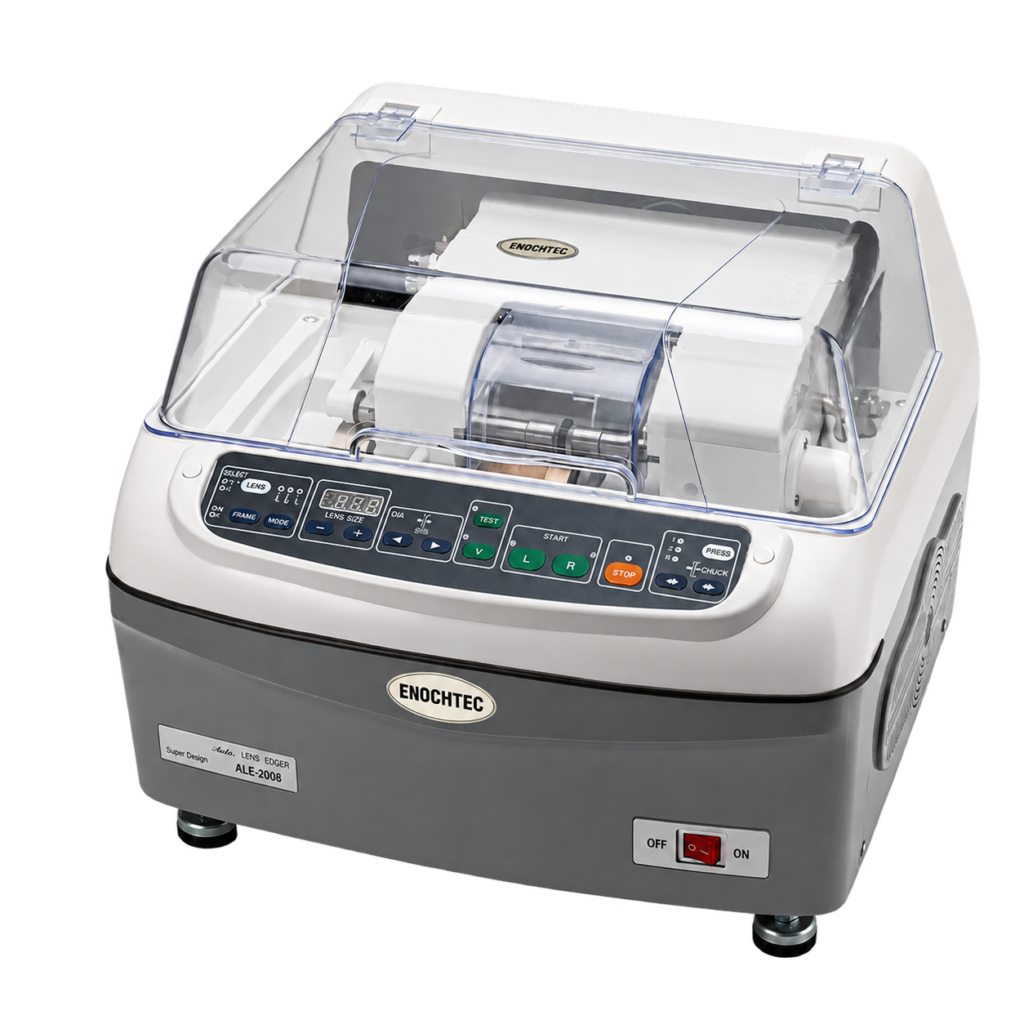
ALE-2008 Automatic Lens Edger
The ALE-2008 automatic lens edger supports mineral-glass and plastic or resin lens processing, bevel and flat-edge modes, polishing, re-beveling and automatic re-grinding across a 26–110 mm range.

Automatic lens edgers shape ophthalmic lenses for selected frame and finishing workflows. Compare ENOCHTEC systems by tracing, blocking, edging, grooving and supported lens-processing functions.
Buying guide
An automatic lens edger shapes an uncut ophthalmic lens to the frame outline and finishes its edge, so the lens can be mounted in the customer's frame. In most optical labs the edger works together with a tracing or centering step: the frame or sample-lens shape is captured, the optical center is positioned, and the edger then grinds and finishes the lens to that shape.
ENOCHTEC currently offers three automatic lens edging options for optical shops, in-house labs and distributors. They differ mainly in how the shape is captured, which edge finishes are available and how far the workflow can be expanded.
Swipe sideways to compare all three systems →
| ALE-2008 | FC-600 + FE-620 | FC-750 + FE-750 Pro | |
|---|---|---|---|
| System type | Automatic lens edger with pattern-making and centering units | Optical center scanner + automatic lens edger | Center scanner with 9.7-inch touchscreen + automatic lens edger |
| Shape capture | Adjustable template system | Frame-shape capture in approx. 3 seconds, real-time centration display | Lens-perimeter scanning, automatic sample-lens centering |
| Edge finishes | V-bevel, flat edge, re-bevel, polishing | Edging, forming and flat-edge polishing | Sharp edge, mini sharp edge, flat edge, polishing, grooving, mixed finishing |
| Lens materials | Dedicated wheels for mineral glass and plastic/resin | Confirmed with quotation | Confirmed with quotation |
| Working range | 26–110 mm grinding range | Confirmed with quotation | Confirmed with quotation |
| Data & workflow | Microcomputer control, pattern selection, size adjustment | Shape storage and editing; supports a connected two-edger configuration | File saving, task management, USB-based updates; milling-cutter processing |
| Typical fit | Optical shops starting in-house edging with a straightforward workflow | Labs that want scanner-based centration and room to add a second edger | Labs handling a wider mix of edge finishes, including grooved and mixed jobs |
Specifications are taken from each product page. Final configuration, accessories and electrical data are confirmed in the quotation for your destination market.
Planning a complete lab? See the optical lab setup guide for the full workflow and equipment list.
It grinds an uncut spectacle lens to the shape of the frame and finishes the edge — for example with a bevel, a flat edge or a polished edge — so the lens can be mounted. The shape and optical center are usually captured first with a template, tracer or center scanner.
A template-based edger such as the ALE-2008 uses a pattern and a centering unit to set the shape and center. A scanner-based system such as the FC-600 + FE-620 or FC-750 + FE-750 Pro captures the shape digitally, shows centration on screen and can store shapes for repeat jobs.
The ALE-2008 has dedicated grinding wheels for mineral glass and for plastic or resin lenses. For the scanner-based systems, the supported lens materials are confirmed with the quotation.
Yes. Rimless mounting requires drilling holes in the lens. ENOCHTEC offers the NH-3GS digital automatic lens drilling machine for this step.
Tell us the lens materials and frame types you handle, your expected daily job volume, whether you already have a tracer or scanner, the power supply in your country, and the destination for shipping.
Share your lens materials, frame types and daily volume. We will recommend a configuration and send a quotation.
The ALE-2008 automatic lens edger supports mineral-glass and plastic or resin lens processing, bevel and flat-edge modes, polishing, re-beveling and automatic re-grinding across a 26–110 mm range.
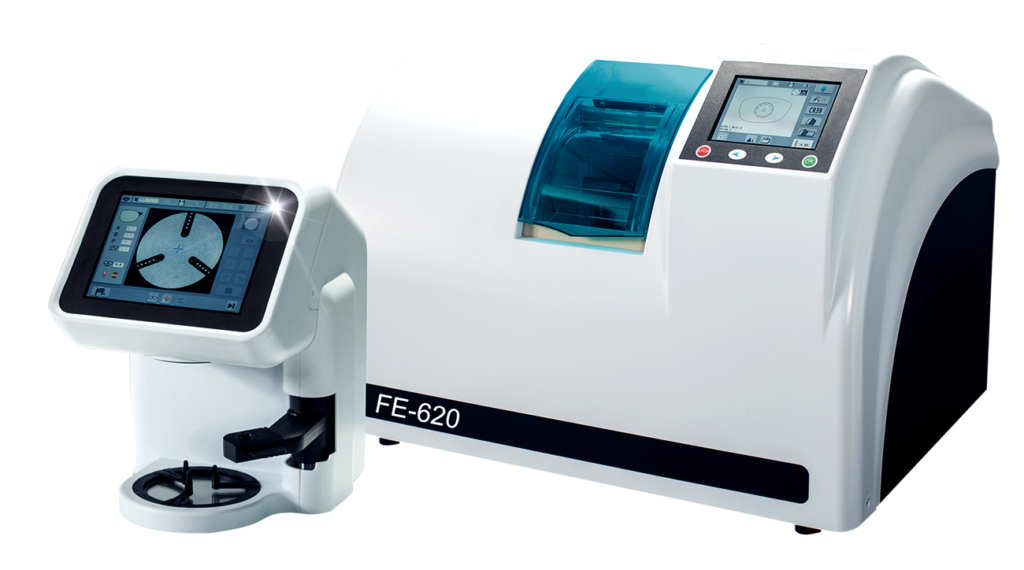
Integrated optical-laboratory system pairing the FC-600 optical center scanner with the FE-620 automatic lens edger for tracing, centration and lens-finishing workflows.
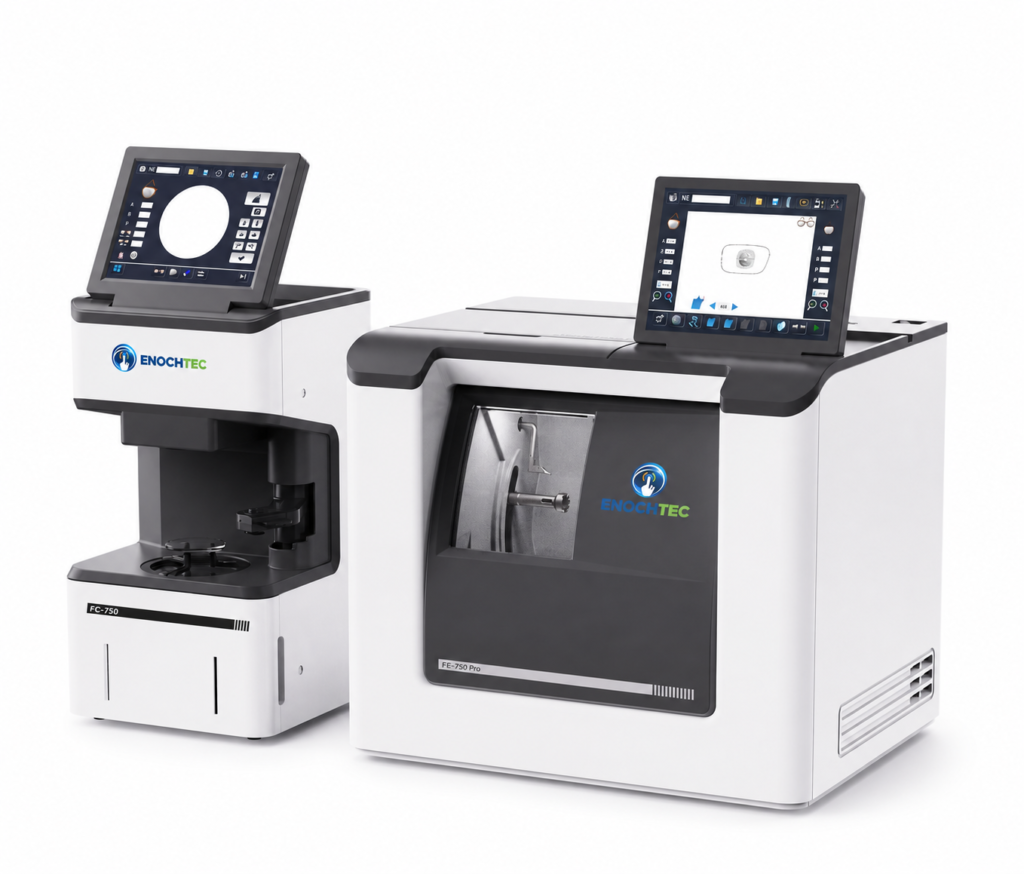
Premium FC-750 contour scanner and FE-750 Pro automatic lens edger system for centering, grooving, polishing and milling in optical labs.